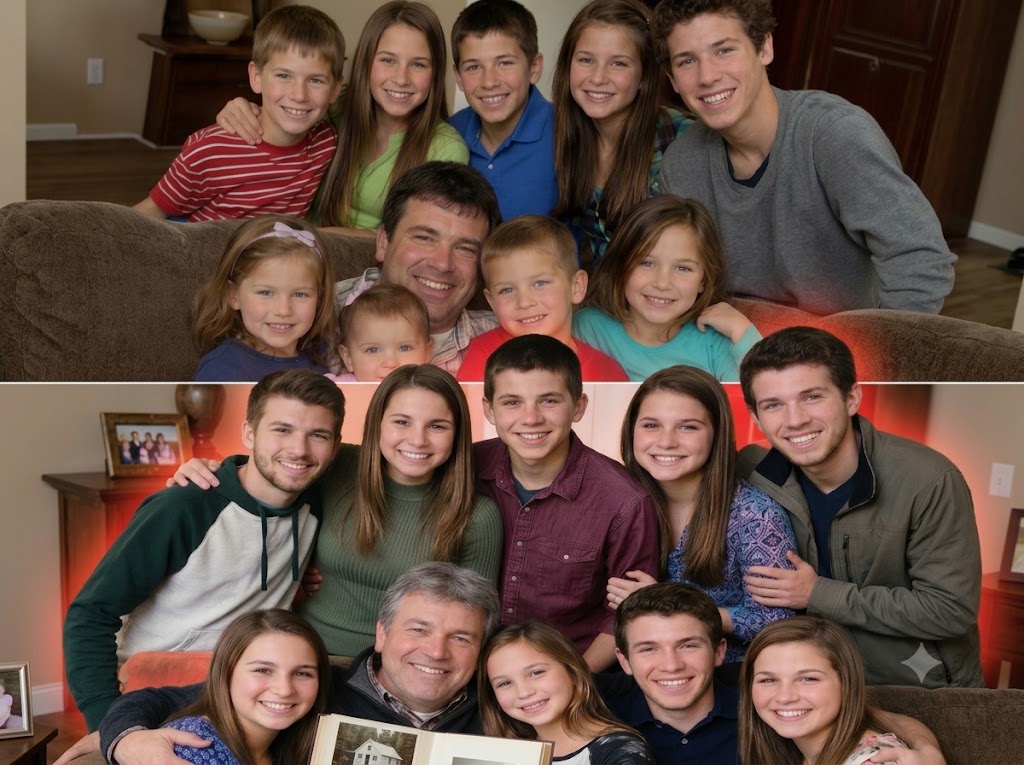
For twelve years, the sound of heavy rain has made my chest tighten. In our small, coastal town, the storm of 2014 is something nobody talks about, but nobody forgets. It was the night the sky turned black, the ocean broke its barriers, and my sister, Clara, vanished without a trace.
Clara was a whirlwind of energy, a single mother who loved her kids fiercely. But she was also overwhelmed, left to raise nine children on her own. The night she disappeared, she went out into the gale to secure our family’s old fishing boat. She never came back. The coast guard found the boat smashed against the rocks, empty. A week of searching yielded nothing.
At twenty-four years old, with my own life just starting, I looked at nine sobbing children—ranging from twelve years old down to nine-month-old Leo—and made a choice. I became their mother.
The next decade was a blur of survival. I traded my college dreams for shifts at the local diner and a night job cleaning offices. Cooking dinner meant prepping massive pots of pasta; laundry was an unending mountain that swallowed my living room. There were nights I locked myself in the bathroom just to cry where they couldn’t hear me, exhausted down to my bones. But every milestone—first steps, high school graduations, loose teeth, and driving lessons—belonged to us. We became an unbreakable unit.
Leo, the youngest, was the anchor of my heart. He had no memory of Clara; to him, I was the only mother he had ever known. He grew into a quiet, observant twelve-year-old, possessing an uncanny ability to read the room and a strange fascination with the ocean that had stolen his mother.
Yesterday, the first major summer storm of 2026 hit our town. As lightning cracked across the sky, the power flickered and died. The older kids, now mostly young adults, systematically gathered candles and blankets, a routine we had perfected over the years. We huddled in the living room, listening to the wind howl against the windowpanes.
I sat on the couch, rubbing my temples, the familiar phantom ache of Clara’s absence settling into my bones. Leo sat on the floor, flipping through an old, water-damaged photo album we had managed to salvage from Clara’s house years ago.
Suddenly, Leo froze. He stared at a photograph that had been stuck to the back of another page, one we had somehow missed during a dozen years of flipping through the book. It was a picture of Clara standing in front of a small, distinctive white cabin nestled in a pine forest, a mountain peak looming in the background. On the back, written in Clara’s hurried handwriting, was a name: Eldora.
Leo looked up from the album. The flickering candlelight caught his eyes, which were wide and completely serious.
“I know where Mom is now,” he said.
The room went dead silent. His older siblings stopped talking. I felt the air leave my lungs. “Leo, sweetheart, we’ve talked about this,” I said, my voice trembling. “Mom went into the ocean during the storm. She’s gone.”
“No, she didn’t,” Leo insisted, standing up and handing me the photo. “Look at the date on the back of the print. It’s stamped three weeks after the storm.”
My hands shook as I turned the photo over. My eyes scanned the faded ink of the developer’s stamp: November 24, 2014. The storm had been on November 2nd.
“And look at this,” Leo whispered, pulling up a map on his phone, which was running on weak cellular data. He pointed to a tiny, isolated mountain town three hundred miles north, deep in the wilderness, named Eldora. “Last week, when I was looking at local hiking forums for a school project, I saw a recent video of a woman running a small bakery there. I thought I was crazy. I thought I was just dreaming. But she has the same laugh, the same scar on her wrist. And now this photo proves she was alive after she disappeared.”
The older kids crowded around, gasping as the reality settled in. Clara hadn’t drowned. She had used the chaos of the storm to stage her disappearance, fleeing the crushing weight of her life and leaving her nine children behind.
A wave of conflicting emotions crashed over me: profound relief that she was alive, followed instantly by a searing, blinding anger. I had sacrificed my youth, my finances, and my dreams to pick up the pieces she deliberately abandoned.
I looked around the room at the nine incredible human beings I had raised. They were kind, resilient, and fiercely loyal to one another. Clara had missed all of it.
“What do we do, Aunt Sarah?” Leo asked softly.
I looked at the photograph of my sister, then back at the beautiful family we built without her. “We pack our bags,” I said, my voice steady. “We are going to go get some answers.”